Description
Form:
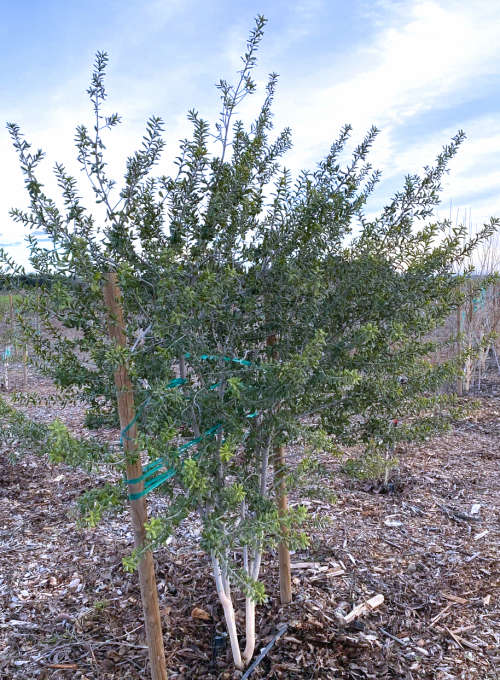
A multi-trunked shrub or small tree with a vase or lollipop shape.
Lifespan:
30 to 50 years.
Leaf retention:
Semi-evergreen in frost-free regions, with a brief leaf drop in early spring followed
immediately by new leaves.
It is deciduous in frost-prone locations and may drop leaves in extended droughts or sudden
freezes where freezing temperatures seldom occur.
Growth rate:
Slow.
Mature Size:
Usually 16-20' (5-6m) high and one-half to three-quarters as wide.
Flowers:
Male and female flowers appear on different trees beginning 5-6 years after seedlings are
planted.
Female flowers are small, 1/4" to 1/2" (1.2-2.5cm) wide, tubular, with five lobes, white
turning to brown with age, fragrant, and grow singly or sometimes in pairs.
Male flowers are smaller, also fragrant, and grow in clusters.
Bloom:
Mid winter through spring.
Fruit:
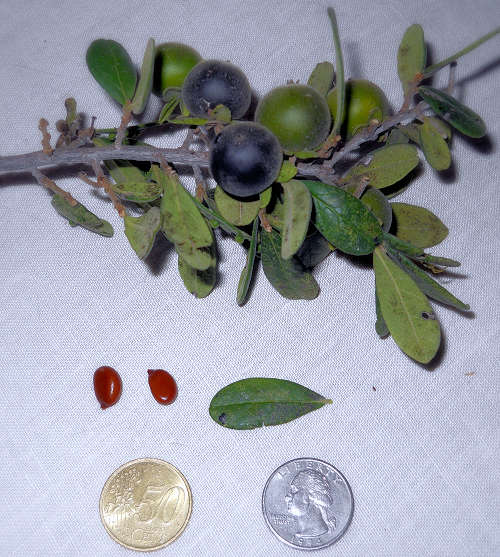
A round to ovate berry containing 3-8 hard seeds, thick dark purple to black skin when ripe,
with black pulp, 1/2"-1" (1.2-2.5cm) wide.
The small, seedy fruit are astringent while green and ripen in late summer.
When ripe, they are edible, can permanently stain clothes, and persist on the tree.
While some females may produce fruit without pollination (parthenocarpy), two trees,
a male and female, are needed for viable seed and abundant fruit.
In the wild, male trees greatly outnumber females.
Leaves:
Green, oval but tapered at the stem, small, hard, stiff, and leathery.
These leaves are adapted to hot, dry conditions and nutrient poor soil.
Stems:
This tree normally grows with multiple trunks but can be grown with one.
The trunks have smooth, grey, thin bark which is easily damaged by impact, and often
twisted branches.
There are no thorns.
After 10 years, peeling bark develops on the trunks in grey, white and pink colors.
Roots:
A long taproot (3-10 feet deep) and an extensive root system make transplantation
difficult.
Horizontal roots (rhizomes) may send up shoots which need to be chopped off if not mowed.
Wildlife:
The flowers attract bees, butterflies, moths, and hummingbirds.
The plant is a host plant for the Grey Hairstreak butterfly.
The fruit, if any, attract birds and mammals.
In the wild, seedlings sprout from animal droppings and not fallen fruit.
The foliage may be browsed by deer.
Toxic / Danger:
No.
Origin:
South Central Texas and Northeast Mexico.
This region has warm winters and hot dry summers with rainfall in spring and fall.
Cultivation and Uses
USDA hardiness zones:
7-9.
Heat tolerant:
Yes.
Drought tolerant:
Yes.
Sun:
Full sun.
Planting:
Plant this tree in full sun in well draining soil.
Trees should be spaced 18-20' (5.5-6m) apart.
Soil:
Very well draining, dry, low in nutrient content, pH 7-8 (neutral to alkaline).
This plant grows best in shallow, rocky limestone soils but is tolerant of most
southwestern soils and is moderately salt tolerant.
Fertilization is unnecessary and may result in weak rapid growth.
Water after becoming established:
Deep water once a month.
The topsoil should dry out between waterings.
Overwatering can result in root rot and fungal infections.
Mulch:
New plantings can benefit from mulch in the first year.
Established plants should not be mulched.
First Year Care:
Deep water modestly immediately after planting, then twice a week while letting the topsoil
go dry between waterings.
Taper off to once a week after a few months, then once a month by winter.
Do not overwater.
Mulch around the plant, keeping mulch 4" (10cm) away from the trunk.
Do not fertilize the first two years, if ever.
Prune:
Lightly trim to shape in winter if needed after the plant is two years in the ground.
Litter:
Fruit drop occurs for a short time from some female trees.
The soft fruit can stain sidewalks.
Propagation:
Fresh seed have a high germination rate when separated from pulp, scarified and grown in a
warm location.
The pulp contains a chemical that inhibits germination.
Dried seed may take nearly a year to germinate under favorable conditions.
Seedlings are slow growing and can be planted outside after the last frost.
They may need part shade for the first few days outside to adapt to intense sunlight.
Uses:
Ornamental, wildlife attraction, xeric garden.
When its thick bitter skin is removed, the soft ripe fruit can be seeded and used to
flavor puddings and jellies.
A staining black dye is made from the ripe fruit.
Furniture and tools have been made from the black heartwood of large trunks.
Comments
Texas Persimmon is a member of the Ebony family (Ebenaceae), which contains over 790
Diospyros species, and is closely related to other edible persimmons.
Other common names are Mexican Persimmon and Chapote.
Once established, this plant thrives on neglect.
Do you have additional information or a different experience for this plant that you would
like to share? Email info@GardenOracle.com. All contributions are welcome and appreciated.